What Is the Requirement for an Element to Undergo Disproportionation Reactions
Disproportionation reaction, also sometimes called dismutation reaction, is basically a blazon of redox reaction involving simultaneous reduction and oxidation of atoms of the aforementioned element from one oxidation state (OS) to two different oxidation states. Basically, one compound of intermediate oxidation state gets converted to two compounds, i with higher and one with lower oxidation states. And so a species is simultaneously reduced and oxidized to form two different products.
In general, the term disproportionation reaction can be applied to any desymmetrization reaction of the following type:
2A → A' + A",
This is regardless of whether it is a redox or another type of process.
As for the requirement for disproportionation reaction to occur, an element undergoing disproportionation must showcase a minimum of 3 different oxidation states. Additionally, the element should be less stable in a particular oxidation land. This allows information technology to be oxidized as well as reduced to a relatively more than stable oxidation state.
The first disproportionation reaction that was studied in detail was;
2 Sn2+ → Sn4+ + Sn
A Finnish chemist named Johan Gadolin examined the reaction using tartrates in the year 1788. It has been recorded in the Swedish version of his paper chosen 'söndring'.
How to Make up one's mind if an Element in a Particular Oxidation State Undergoes a Disproportionation Reaction?
If an element's iii oxidation states are written either in the increasing or decreasing guild, the chemical element in the eye oxidation state will probable be less stable whereas the higher and lower oxidation states will be relatively more than stable. The overall process has to be thermodynamically feasible.
More significantly, the Latimer diagrams tin exist used to predict whether an atom in a particular oxidation land can go through disproportionation or not. If nosotros look at the Latimer diagram, we will find that the unstable species that tin undergo disproportionation will have a greater positive emf value to its correct (for reduction) than the emf to its left (for oxidation).
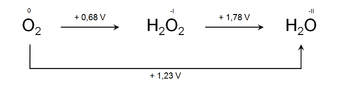
Also Read: Oxidation and Reduction
Disproportionation Reaction Examples
Let us look at a few examples of disproportionation reactions.
Instance 1: Decomposition reaction of hydrogen peroxide. Here oxygen experiences disproportionation.
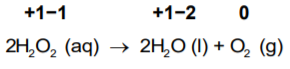
So, the oxygen of peroxide present in the −i state gets converted to the cipher oxidation country in O2 and at the aforementioned time decreases to the −2 oxidation country in H2O.
Case 2: Upon UV-irradiation, mercury(I) chloride undergoes disproportionation.
Hg2Cltwo → Hg + HgCl2
Example 3: Phosphorous acid when heated undergoes disproportionation to produce phosphoric acid and phosphine:
4 H3PO3 → three H3POiv + PH3
Desymmetrization Reactions
Alternatively, desymmetrization reactions are likewise sometimes called disproportionation. This is mainly illustrated by the thermal degradation of bicarbonate:
2HCO-3 → CO2-3 + HtwoCOthree
The oxidation numbers remain constant in this acrid-base of operations reaction and this process is also called autoionization.
Radical Disproportionation
Disproportionation besides has another variant which is known as radical disproportionation. Here ii radicals tend to form an alkane series and alkene.
In other instances, if y'all look at Cannizzaro reaction likewise, an aldehyde is converted into alcohol and a carboxylic acrid. In the related Tishchenko reaction, the organic redox reaction product is the corresponding ester. In the Kornblum–DeLaMare rearrangement, peroxide is converted to ketone and alcohol.
Other Examples
1. The reaction of chlorine gas with dilute sodium hydroxide that results in the formation of sodium chloride, sodium chlorate and water. The ionic equation for this reaction is as follows:
3 Cl2 + 6 OH− → 5 Cl− + ClO3 − + 3 H2O
Here, the chlorine reactant is in oxidation state 0 and if we look at the products, the chlorine in the Cl− ion has an oxidation number of −1 where information technology has undergone reduction. Meanwhile, the oxidation number of the chlorine in the ClO3− ion is +v meaning it has been oxidized.
2. Disproportionation can be seen in the decompositions of numerous interhalogen compounds. For example, bromine fluoride can go through a disproportionation reaction to course bromine trifluoride and bromine.
3BrF → BrF3 + Br2
3. If we report the Boudouard reaction, we volition come to see that carbon monoxide easily disproportionates to carbon and carbon dioxide. While the reaction is an instance for the HiPco method that is used for producing carbon nanotubes, loftier-pressure level carbon monoxide goes undergoes disproportionation when it is catalysed on the surface of an iron particle:
2 CO → C + COtwo
4. In nitrogen dioxide, nitrogen has an oxidation state +iv. When this compound is reacted with water, information technology results in the germination of both nitric acrid and nitrous acrid wherein nitrogen has oxidation states +v and +iii respectively:
2 NO2 + H2O → HNO3 + HNO2
Contrary Reaction
When a compound in an intermediate oxidation state is formed from precursors of lower and higher oxidation states it is the opposite of disproportionation. This procedure is known every bit comproportionation which is as well sometimes referred to as synproportionation.
Disproportionation Reaction Video Lesson

Source: https://byjus.com/jee/disproportionation-reaction/
0 Response to "What Is the Requirement for an Element to Undergo Disproportionation Reactions"
ارسال یک نظر