Janusz Korczak When I Am Little Again Ebay
| Janusz Korczak | |
|---|---|
 Janusz Korczak, photographed c. 1930 | |
| Born | Henryk Goldszmit (1878-07-22)22 July 1878 Warsaw, Congress Poland, Russian Empire |
| Died | c. 7 August 1942(1942-08-07) (aged 64) Treblinka extermination military camp, German-occupied Poland |
| Nationality | Polish |
| Occupation | Children's writer, humanitarian, pediatrician, child pedagogue and defender of children's rights |
| Website | korczak |
Janusz Korczak, the pen name of Henryk Goldszmit [one] (22 July 1878 or 1879 – vii August 1942),[2] was a Polish Jewish educator, children's author and pedagogue known as Pan Doktor ("Mr. Md") or Stary Doktor ("Old Dr."). After spending many years working every bit a principal of an orphanage in Warsaw, he refused sanctuary repeatedly and stayed with his orphans when the entire population of the institution was sent from the Ghetto to the Treblinka extermination camp by the Nazis, during the Grossaktion Warschau of 1942.[3]
Biography [edit]
Korczak was born in Warsaw in 1878. He was unsure of his birth engagement, which he attributed to his father's failure to promptly acquire a nascency certificate for him.[4] His parents were Józef Goldszmit,[ane] a respected lawyer from a family unit of proponents of the haskalah,[v] and Cecylia née Gębicka, daughter of a prominent Kalisz family.[6] Born to a Jewish family unit, he was an agnostic in his later life who did not believe in forcing organized religion on children.[7] [8] [nine] His father fell ill around 1890 and was admitted to a mental infirmary, where he died half dozen years subsequently on 25 April 1896.[10] [eleven] Spacious apartments were given up on Miodowa street, so Świętojerska.[12] As his family's financial situation worsened, Henryk, while yet attending the gymnasium (the current 8th Lycée in Warsaw), began to work equally a tutor for other pupils.[12] In 1896 he debuted on the literary scene with a satirical text on raising children, Węzeł gordyjski (The Gordian Knot).[6]
In 1898, he used Janusz Korczak as a pen name in the Ignacy Jan Paderewski Literary Contest. The name originated from the volume Janasz Korczak and the Pretty Swordsweeperlady (O Janaszu Korczaku i pięknej Miecznikównie) by Józef Ignacy Kraszewski.[13] In the 1890s he studied in the Flying University. During the years 1898–1904 Korczak studied medicine at the University of Warsaw[4] and also wrote for several Polish language newspapers. Later graduation, he became a pediatrician. In 1905−1912 Korczak worked at Bersohns and Baumans Children's Infirmary in Warsaw. During the Russo-Japanese War, in 1905–06 he served as a armed services doctor. Meanwhile, his book Child of the Cartoon Room (Dziecko salonu) gained him some literary recognition.

Janusz Korczak with the children in 1920s

The orphanage at 92 Krochmalna Street where Korczak worked. He lived in a room in the attic which was destroyed during World War 2 and not rebuilt
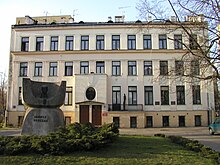
Korczak'southward orphanage is still in functioning at 6 Jaktorowska Street
In 1907–08, Korczak went to study in Berlin. While working for the Orphans' Club in 1909, he met Stefania Wilczyńska, his future closest associate. In 1911–1912, he became a director of Dom Sierot in Warsaw, an orphanage of his ain design for Jewish children.[14] He hired Wilczyńska as his assistant. There he formed a kind-of-a-republic for children with its own modest parliament, court, and a paper. He reduced his other duties as a doctor. Some of his descriptions of the summer camp for Jewish children in this period and subsequently, were after published in his Fragmenty Utworów and accept been translated into English language.
During World State of war I, in 1914 Korczak became a military doctor with the rank of lieutenant. He served again as a military dr. in the Polish Regular army with the rank of major during the Polish-Soviet War, but afterward a brief stint in Łódź was assigned to Warsaw. Afterward the wars, he continued his practice in Warsaw. Korczak was a lifelong bachelor and had no biological children of his own.[15] [xvi]
Sovereign Poland [edit]
In 1926, Korczak bundled for the children of the Dom Sierot (Orphan House) to begin their own newspaper, the Mały Przegląd (Footling Review), as a weekly attachment to the daily Polish-Jewish paper Nasz Przegląd (Our Review). In these years, his secretary was the noted Polish novelist Igor Newerly.[ citation needed ] His orphanage was supported by the CENTOS Polish-Jewish charity.[17]
During the 1930s, he had his own radio program where he promoted and popularized the rights of children. In 1933, he was awarded the Silverish Cantankerous of the Polonia Restituta. Between 1934–36, Korczak travelled every twelvemonth to Mandate Palestine and visited its kibbutzim, which led to some anti-semitic commentaries in the Shine press[ commendation needed ]. Additionally, it spurred his estrangement with the non-Jewish orphanage for which he had likewise been working. A letter he wrote indicates that he had some intentions to move to Palestine, simply at the end, he felt he couldn't leave his children behind.[18] [ unreliable source? ] He stayed in Poland, even when Wilczyńska went to alive in Palestine in 1938 and continued his function as headmaster.[19] [ unreliable source? ]
The Holocaust [edit]

Concluding issue of Mały Przegląd (Little Review) dated 1 September 1939
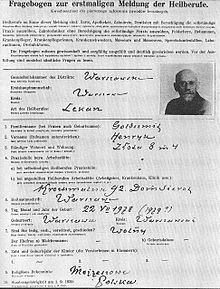
Korczak's filling card prepared during compulsory registration of physicians ordered by the German occupation authorities in Warsaw in 1940

Building of Państwowa Szkoła Handlowa Męska im. J. i M. Roeslerów, between November 1940 and Oct 1941 the seat of Dom Sierot in the Warsaw Ghetto
In 1939, when World State of war II erupted, Korczak volunteered for duty in the Smoothen Army, simply was refused due to his age. He witnessed the Wehrmacht takeover of Warsaw. When the Germans created the Warsaw Ghetto in 1940, his orphanage was forced to move from its building, Dom Sierot at Krochmalna 92, to the Ghetto (first to Chłodna 33 and later to Sienna 16 / Śliska 9).[20] Korczak moved in with them. In July, Janusz Korczak decided that the children in the orphanage should put on Rabindranath Tagore's play The Postal service Role.
On five or 6 Baronial 1942, German soldiers came to collect the 192 orphans (there is some argue about the actual number: it may accept been 196) and about 1 dozen staff members to transport them to the Treblinka extermination military camp. Korczak had been offered sanctuary on the "Aryan side" past the Shine underground organisation Żegota, but turned it down repeatedly, proverb that he could not abandon his children. On 5 August, he again refused offers of sanctuary, insisting that he would go with the children.
The children were dressed in their all-time clothes, and each carried a blue knapsack and a favorite book or toy. Joshua Perle, an eyewitness whose wartime writings were saved in the Ringelblum Archive,[21] described the procession of Korczak and the children through the Ghetto to the Umschlagplatz (deportation point to the decease camps):
Janusz Korczak was marching, his head aptitude forwards, belongings the manus of a child, without a lid, a leather belt around his waist, and wearing high boots. A few nurses were followed by ii hundred children, dressed in clean and meticulously cared for apparel, as they were being carried to the chantry.
—Ghetto eyewitness, Joshua Perle[22]
According to eyewitnesses, when the group of orphans finally reached the Umschlagplatz, an SS officer recognized Korczak as the writer of one of his favorite children's books and offered to help him escape. In another version, the officer was acting officially, as the Nazi authorities had in mind some kind of "special handling" for Korczak (some prominent Jews with international reputations were sent to Theresienstadt). Whatever the offer, Korczak once again refused. He boarded the trains with the children and was never heard from again. Korczak's evacuation from the Ghetto is also mentioned in Władysław Szpilman's book The Pianist:
He told the orphans they were going out into the country, then they ought to exist cheerful. At last they would be able to commutation the horrible suffocating metropolis walls for meadows of flowers, streams where they could bathe, forest full of berries and mushrooms. He told them to wear their all-time clothes, and so they came out into the k, two past two, nicely dressed and in a happy mood. The little cavalcade was led by an SS homo...
One-time later, in that location were rumours that the trains had been diverted and that Korczak and the children had survived. There was, nonetheless, no basis to these stories. Nearly probable, Korczak, forth with Wilczyńska and most of the children, was murdered in a gas chamber after arriving at Treblinka. A dissever account of Korczak's difference is given in Mary Berg's Warsaw Ghetto diary:
Dr. Janusz Korczak'due south children's habitation is empty now. A few days ago we all stood at the window and watched the Germans surroundings the houses. Rows of children, holding each other by their picayune hands, began to walk out of the doorway. At that place were tiny tots of two or 3 years amidst them, while the oldest ones were perhaps thirteen. Each kid carried the little bundle in his hand.
—Mary Berg, The Diary [24]
Writings [edit]
Korczak'southward best known writing is his fiction and pedagogy, and his most popular works have been widely translated. His main pedagogical texts have been translated into English, but of his fiction, as of 2012[update], simply ii of his novels accept been translated into English: King Matt the Get-go and Kaytek the Wizard.
As the date of Korczak's death was non officially established, his date of death for legal purposes was established in 1954 by a Polish court equally ix May 1946, a standard ruling for people whose death date was not documented but in all likelihood occurred during World State of war II. The copyright to all works by Korczak was subsequently acquired by The Smooth Volume Institute (Instytut Książki), a cultural institution and publishing business firm affiliated with the Smooth regime. In 2012 the Plant's rights were challenged by the Modern Poland Foundation, whose goal was to found by court trial that Korczak died in 1942, so that Korczak'southward works would be bachelor in the public domain as of 1 January 2013. The Foundation won the case in 2015 and subsequently started to digitise Korczak'southward works and release them as public domain due east-books.[25] [26] [27]
Korczak's overall literary oeuvre covers the period 1896 to 8 August 1942. It comprises works for both children and adults, and includes literary pieces, social journalism, manufactures and pedagogical essays, together with some scraps of unpublished piece of work, totalling over xx books, over i,400 texts published in around 100 publications, and around 300 texts in manuscript or typescript form. A complete edition of his works is planned for 2012.[28]
Children's books [edit]
Korczak often employed the form of a fairy tale in order to prepare his immature readers for the dilemmas and difficulties of real developed life, and the need to make responsible decisions.
In the 1923 King Matt the Kickoff (Król Maciuś Pierwszy) and its sequel King Matt on the Desert Island (Król Maciuś na wyspie bezludnej) Korczak depicted a kid prince who is catapulted to the throne by the sudden death of his begetter, and who must larn from various mistakes:
He tries to read and answer all his mail by himself and finds that the book is too much and he needs to rely on secretaries; he is exasperated with his ministers and has them arrested, but soon realises that he does not know plenty to govern by himself, and is forced to release the ministers and institute constitutional monarchy; when a war breaks out he does not accept being shut up in his palace, simply slips away and joins up, pretending to exist a peasant boy - and narrowly avoids becoming a Pow; he takes the offering of a friendly journalist to publish for him a "royal paper" -and finds much later that he gets carefully edited news and that the journalist is covering upwards the gross corruption of the immature male monarch's best friend; he tries to organise the children of all the world to agree processions and need their rights – and ends upward antagonising other kings; he falls in honey with a blackness African princess and outrages racist stance (by mod standards, however, Korczak'southward depiction of blacks is itself non completely free of stereotypes which were current at the fourth dimension of writing); finally, he is overthrown past the invasion of 3 foreign armies and exiled to a desert island, where he must come up to terms with reality – and finally does.
In 2012, another book by Korczak was translated into English language. Kajtuś the Magician (Kajtuś czarodziej) (1933) predictable Harry Potter in depicting a schoolboy who gains magic powers, and information technology was very popular during the 1930s, both in Polish and in translation to several other languages. Kajtuś has, however, a far more difficult path than Harry Potter: he has no Hogwarts-type School of Magic where he could be taught by expert mages, merely must acquire to employ and command his powers all by himself - and most importantly, to learn his limitations.
Korczak's The Persistent Boy was a biography of the French scientist Louis Pasteur, adjusted for children - as stated in the preface - from a 685-page French biography which Korczak read. The book clearly aims to portray Pasteur equally a role model for the kid reader. A considerable part of the book is devoted to Pasteur's childhood and adolescence, and his relations with parents, teachers and schoolmates. It is emphasised that Pasteur, destined for world-wide fame, started from inauspicious beginnings - built-in to poor working-class parents in an obscure French provincial town and attending a far from high-quality school. There, he was far from a star student, his marks oftentimes falling below average. As repeatedly emphasised by Korczak, Pasteur's achievements, both in childhood and in later academic and scientific career, were mainly due to persistence (every bit hinted in the title), a relentless and eventually successful effort to overcome his limitations and early failures.
Pedagogical books [edit]
In his pedagogical works, Korczak shares much of his experience of dealing with difficult children. Korczak's ideas were further developed by many other pedagogues such as Simon Soloveychik and Erich Dauzenroth.
Thoughts on corporal penalisation [edit]
Korczak spoke confronting corporal punishment of children at a time when such treatment was considered a parental entitlement or even duty. In The Kid'southward Right to Respect (1929), he wrote,
In what extraordinary circumstances would ane cartel to push, hit or tug an developed? And nevertheless it is considered and so routine and harmless to requite a kid a tap or stinging smack or to take hold of him by the arm. The feeling of powerlessness creates respect for power. Not only adults but anyone who is older and stronger can cruelly demonstrate their displeasure, support their words with force, demand obedience and abuse the child without beingness punished. We prepare an example that fosters contempt for the weak. This is bad parenting and sets a bad precedent.[29]
List of selected works [edit]
Fiction [edit]
- Children of the Streets (Dzieci ulicy, Warsaw 1901)
- Fiddle-Faddle (Koszałki opałki, Warsaw 1905)
- Child of the Drawing Room (Dziecko salonu, Warsaw 1906, 2nd edition 1927) – partially autobiographical
- Mośki, Joski i Srule (Warsaw 1910)
- Józki, Jaśki i Franki (Warsaw 1911)
- Fame (Sława, Warsaw 1913, corrected 1935 and 1937)
- Bobo (Warsaw 1914)
- Rex Matt the Offset (Król Maciuś Pierwszy, Warsaw 1923) ISBN i-56512-442-1
- King Matt on a Deserted Island (Król Maciuś na wyspie bezludnej, Warsaw 1923)
- Bankruptcy of Little Jack (Bankructwo małego Dżeka, Warsaw 1924)
- When I Am Little Again (Kiedy znów będę mały, Warsaw 1925)
- Senat szaleńców, humoreska ponura (Madmen'south Senate, play premièred at the Ateneum Theatre in Warsaw, 1931)
- Kaytek the Wizard (Kajtuś czarodziej, Warsaw 1935)
Pedagogical books [edit]
- Momenty wychowawcze (Warsaw, 1919, 2nd edition 1924)
- How to Love a Child (Jak kochać dziecko, Warsaw 1919, 2nd edition 1920 equally Jak kochać dzieci)
- The Child'due south Right to Respect (Prawo dziecka exercise szacunku, Warsaw, 1929)
- Playful Teaching (Pedagogika żartobliwa, Warsaw, 1939)
Other books [edit]
- Diary (Pamiętnik, Warsaw, 1958)
- Fragmenty Utworów
- The Stubborn Male child: The Life of Pasteur (Warsaw, 1935)
Remembrance [edit]
Korczak is commemorated in a number of monuments and plaques in Poland, mainly in Warsaw.[thirty] The all-time known of them is the cairn located at the Okopowa Street Jewish Cemetery, which serves as his symbolic grave. It is a monumental sculpture of Korczak leading his children to the trains. Created originally by Mieczysław Smorczewski in 1982,[31] the monument was recast in bronze in 2002. The original was re-erected at the boarding school for children with special needs in Borzęciczki, which is named afterward Janusz Korczak.[32]
All the same, the monument set in the Świętokrzyski Park in 2006 is not only the largest but likewise, due to its very convenient location, the most frequently visited by schoolhouse trips and tourists monument commemorating Korczak. Every year, effectually June 1, on Children'southward Day, trips from Warsaw schools go to the monument.[33]
Due to decommunization policies the Nikolay Bauman street in (Ukraine's capital) Kyiv was renamed after Korczak in 2016.[34]
A minor planet, 2163 Korczak, is named after him.[35]
-

Janusz Korczak and the children, memorial at Yad Vashem
Cultural references [edit]
In addition to theater, opera, Tv set, and film adaptations of his works, such equally King Matt the First and Kaytek the Magician, there have been a number of works nearly Korczak, inspired past him, or featuring him equally a character.

Israeli postal stamp, 1962
Biographies and legacy [edit]
- Rex of Children: The Life and Expiry of Janusz Korczak by Betty Jean Lifton (1989/2018), an acclaimed biography on the selfless life of Janusz Korczak from childhood and leading upwardly to the Final March he would have with his orphans from the Warsaw Ghetto to the Treblinka-bound cattle cars.
- The influential twentieth-century Hebrew-language educator and publisher Zevi Scharfstein profiled Korczak in his 1964 work Corking Hebrew Educators (גדולי חינוך בעמנו, Rubin Mass Publishers, Jerusalem, 1964).[36]
- Loving Every Kid: Wisdom for Parents edited by Sandra Joseph.[37]
Fiction books [edit]
- Milkweed past Jerry Spinelli (2003) – Doctor Korczak runs an orphanage in Warsaw where the main character ofttimes visits him
- Moshe en Reizele (Mosje and Reizele) past Karlijn Stoffels (2004) – Mosje is sent to live in Korczak's orphanage, where he falls in honey with Reizele. Fix in the period 1939-1942. Original Dutch, German translation available. No English version as of 2009[update].
- Once past Morris Gleitzman (2005), partly inspired by Korczak, featuring a character modelled afterward him
- Kindling by Alberto Valis (Felici Editori, 2011), Italian thriller novel. The life of Korczak through the vocalism of a Warsaw ghetto's orphan. Equally of 2019[update], no English translation.
- The Time Tunnel: Kingdom of the Children by Galila Ron-Feder Amit (2007) is an Israeli children's volume in the Time Tunnel serial that takes place in Korczak's orphanage.
- The Book of Aron past Jim Shepard (2015) is a fictional work that features Dr Korczak and his orphanage in the Warsaw Ghetto equally main characters in the book.
- The Good Doctor of Warsaw by Elisabeth Gifford (2018), a novel based on a truthful story of a young couple who survived the Warsaw ghetto and of Dr Korczak and his orphanage.
Stage plays [edit]
- Dr Korczak and the Children by Erwin Sylvanus (1957)
- Korczak's Children by Jeffrey Hatcher (2003)
- Dr Korczak'southward Example by David Greig (2001)[38]
- The Children's Republic A play based on the life and piece of work of Yanusz Korczak (2008) by Elena Khalitov, Harmony Theatre Visitor and Schoolhouse
- The Children'south Democracy by Hannah Moscovitch (2009)
- Chlodnagaden nr. 33 By Rober Parr with music by Michael Ramløse, Teatret Off-white play (Eng: The Fair Play Theater)[39]
- Monsieur Fugue (1967) by Liliane Atlan is based in office on the story of Korczak[40]
Film [edit]
- Sie sind frei, Dr. Korczak (The Martyr), written by Ben Barzman and Alexander Ramati, directed by Aleksander Ford (1975)
- Korczak, written by Agnieszka Holland, directed by Andrzej Wajda (1990) portrayed by Wojciech Pszoniak
- Uprising (2001) directed by Jon Avnet, written past Avnet and Paul Brickman. Palle Granditsky portrayed Korczak.
- The Courageous Heart of Irena Sendler (2009) directed past John Kent Harrison. Krzysztof Pieczynski played Dr. Janusz Korczak.
- The Zookeeper'southward Wife (2017), directed by Niki Caro. Arnošt Goldflam played Korczak.
Television [edit]
- Studio 4: Dr Korczak and the Children - BBC adaptation of Sylvanus's play, written and directed by Rudolph Cartier (13 March 1962)
Music [edit]
- Kaddish – long poem/song past Alexander Galich (1970)
- Facing the wall - Janusz Korczak – musical by Klaus-Peter Male monarch and Daniel Hoffmann (1997) presented by Music-theatre fuenf brote und zwei fische, Wülfrath
- Korczak's Orphans – opera, music by Adam Silverman, libretto by Susan Gubernat (2003)
- Korczak [41] – musical by Nick Stimson and Chris Williams. Performed by the St Ives Youth Theatre at the Edinburgh Fringe Festival in 2005 and by Youth Music Theatre United kingdom of great britain and northern ireland at the Rose Theatre, Kingston in August 2011
- Male monarch Mattias I - opera, music by Viggo Edén, from writings by Korczak, given World Premiere at Höör's Summer Opera (Sweden) on nine Baronial 2012.
- The Footling Review from anthology Where the Darkness Goes, Awna Teixeira, 2012
- Janusz - piece for piano, music by Nicola Gelo (2013)
Run across too [edit]
- List of Holocaust diarists
- List of diarists
- List of posthumous publications of Holocaust victims
References [edit]
- ^ a b Yad Vashem (2010). "Anniversary Marking 68 Years Since its Murder of Korczak and the Children of the Orphanage". Yad Vashem The Holocaust Martyrs' and Heroes' Remembrance Potency. Retrieved 27 January 2012.
- ^ "Jewish Doctor Janusz Korczak Died With 190 Children at Treblinka Court: Changes Date of Death for Orphanage Manager". JTA. 30 March 2015. Retrieved 30 March 2015.
- ^ Sandra Joseph, Institute of Instruction in London (July–August 2002). "POLE Autonomously - the life and piece of work of Janusz Korczak". Young Minds Magazine 59. Archived from the original on 28 September 2007. Retrieved 27 January 2012.
- ^ a b "Polskie Stowarzyszenie im. Janusza Korczaka". www.pskorczak.org.pl (in Polish). Retrieved 2016-03-12 .
- ^ Tadeusz Lewowicki (2000). "Janusz Korczak (1878–1942)" (PDF, 43 KB). Prospects:the quarterly review of comparative education, vol. XXIV, no. 1/2, 1994, p. 37–48. UNESCO: International Agency of Education. Retrieved 27 Jan 2012.
- ^ a b Prof. Barbara Smolińska–Theiss (2012). "Janusz Korczak – zarys portretu (the portrait)" (in Polish). Rok Janusza Korczaka (The official twelvemonth of Janusz Korczak). Archived from the original on 15 April 2012. Retrieved 27 January 2012.
- ^ The Month, Volume 39. Simpki, Marshall, and Company. 1968. p. 350.
When Dr. Janusz Korczak, a Jewish philanthropist and agnostic, voluntarily chooses to follow the Jewish orphans under his care to the Nazi extermination army camp in Treblinka...
- ^ Chris Mullen (March vii, 1983). "Korczak's Children: Flawed Faces in a Warsaw Ghetto". The Heights. p. 24. Retrieved 25 August 2013.
An alloyed Jew, he changed his name from Henryk Goldschmidt and was an agnostic who did not believe in forcing religion on children.
- ^ Janusz Korczak (1978). Ghetto diary. Holocaust Library. p. 42.
You know I am an agnostic, simply I understood: Instruction, tolerance, and all that.
- ^ Janusz Korczak; Aleksander Lewin (1996). Sława: Opowiadania (1898-1914) (in Smoothen). Oficyna Wydawnicza Latona. p. 387. ISBN978-83-85449-35-5.
- ^ Maria Falkowska (1978). Kalendarium życia, działalności i twórczości Janusza Korczaka (in Polish). Wydaw-a Szkolne i Pedagogiczne. p. 8.
- ^ a b Joanna Cieśla (15 January 2012). "Henryk zwany Januszem. Janusz Korczak - pedagog rewolucjonista" (in Smoothen). S.P. Polityka. Historia. Retrieved 27 January 2012.
- ^ Józef Ignacy Kraszewski (2012). "Moja Biblioteczka". Historia o Janaszu Korczaku i o pięknej Miecznikównie. LubimyCzytać.pl. Retrieved May 25, 2012.
- ^ Hanna Mortkowicz-Olczakowa (1960). "Goldszmit Henryk", in Polski Słownik Biograficzny, T. VIII. P. 214
- ^ "JANUSZ KORCZAK (1878 - 1942) Educator, he followed the Jewish children into the Warsaw Ghetto and in displacement". Gariwo . Retrieved 14 April 2022.
- ^ Chojczak, Szymon (15 August 2018). "The Quondam Doctor who went with his pupils to the gas sleeping room". Great Poles . Retrieved 14 April 2022.
- ^ "CENTOS". Jewish Historical Establish . Retrieved 2020-07-20 .
- ^ Dorit Gani (April x, 2018). "Who Stood with the Orphans When the Nazis Came?". The National Library of Israel. Retrieved 26 November 2019.
- ^ Agnieszka Litwiniuk (March 29, 2012). "Stefania Wilczyńska". Sylwetki warszawskich Żydówek (Profiles of Warsaw Jewish women) (in Smooth). Warszefroj, Centrum Kultury Jidysz (Yidish Middle). Retrieved fourteen Dec 2013.
- ^ "Dom Sierot. Krochmalna 92". Swedish Holocaust Memorial Association. Retrieved 27 January 2012.
- ^ "Perle, Joshua". Encyclopaedia Judaica. Encyclopedia.com. Retrieved June xv, 2019.
- ^ Nick Shepley (7 December 2015). Hitler, Stalin and the Destruction of Poland: Explaining History. Andrews Uk Limited. p. 55. ISBN978-1-78333-143-7.
- ^ Jerzy Waldorff, Władysław Szpilman, The Pianist. Page 96.
- ^ Mary Berg, The Diary of Mary Berg: Growing Up in the Warsaw Ghetto, Oxford: Oneworld Publications, 1996, pages 169-170.
- ^ "Wyrok w sprawie Korczaka – omówienie". Fundacja Nowoczesna Polska . Retrieved 2016-03-12 .
- ^ "Wygrany spór o datę śmierci Korczaka. Prawda pokonała "własność intelektualną"". Dziennik Internautów . Retrieved 2016-03-12 .
- ^ "Author: Janusz Korczak". Wolne Lektury . Retrieved 2016-03-12 .
- ^ "Janusz Korczak", Book Institute
- ^ Modig, Cecilia (2009). Never Violence – Thirty Years on from Sweden's Abolition of Corporal Penalization (PDF). Ministry of Health and Social Diplomacy, Sweden; Save the Children Sweden. Reference No. S2009.030. p. viii.
- ^ Agata Anna Lisiak (2010). Urban Cultures in (post)colonial Central Europe. Purdue University Press. pp. 147–. ISBN978-1-55753-573-3.
- ^ "The Jewish Cemetery on Okopowa Street in Warsaw (Cmentarz żydowski przy ul. Okopowej due west Warszawie)". Cmentarium. 2007. Retrieved Jan 8, 2013.
- ^ Mirosław Gorzelanny (November 27, 2012). "Schoolhouse history". Specjalny Ośrodek Szkolno – Wychowawczy im Janusza Korczaka w Borzęciczkach. Archived from the original on June 26, 2013. Retrieved Jan 8, 2013.
- ^ "Monument to Janusz Korczak (Warsaw)". monuments-remembrance.eu . Retrieved 2020-04-09 .
- ^ (in Ukrainian) Bandera Avenue in Kyiv to be - the decision of the Court of Appeal, Ukrayinska Pravda (22 Apr 2021)
- ^ "(2163) Korczak". IAU Minor Planet Eye.
- ^ Rin, Svi (April 1966). "גדולי חינוך בעמנו Book Review". Jewish Social Studies. 28: 127–128.
- ^ https://korczak.org.united kingdom
- ^ Hickling, Alfred (June 12, 2008). "Dr Korczak'south Example". The Guardian. London.
- ^ "Chlodnagaden nr. 33 - Dit Holbæk". Dit Holbæk (in Danish). 2017-03-fourteen. Retrieved 2017-04-09 .
- ^ Knapp, Bettina (1995). French Theater Since 1968 . New York: Twayne Publishers. ISBN0805782974.
- ^ "Korczak (2011) | British Youth Music Theatre".
Further reading [edit]
- Bystrzycka, Anna (July 2007). "Dzieci z sierocińca". Zwrot: 30–31.
- Cohen, Adir (1994). The Gate of Calorie-free: Janusz Korczak, the Educator and Author who Overcame the Holocaust. Madison, NJ: Fairleigh Dickinson University Press. ISBN978-0-838-63523-0.
- Joseph, Sandra (1999). A Phonation for the Child: The inspirational words of Janusz Korczak. Collins Publishers.
- Lifton, Betty Jean (1988). The Rex of Children: The Life and Death of Janusz Korczak Collins Publishers.
- Mortkowicz-Olczakowa, Hanna (1961). Bunt wspomnień. Państwowy Instytut Wydawniczy.
- Parenting Advice from a Smoothen Holocaust Hero from National Public Radio
- Lawrence Kohlberg (1981). The Philosophy of Moral Development: Education for Justice pp. 401–408. Harper & Row, Publishers, San Francisco.
- Marker Celinscak (2009). "A Procession of Shadows: Examining Warsaw Ghetto Testimony." New School Psychology Message. Book half dozen, Number ii: 38-50.
External links [edit]
- Janusz Korczak Living Heritage Association
- Ojemba Productions presents 'KORCZAK' at the Edinburgh Fringe Festival 2005!
- Korczak'due south Orphans opera past Adam Silverman and Susan Gubernat
- I'm minor, only important, German language Documentary by Walther Petri and Konrad Weiss
- Wiersz Kazimierza Dąbrowskiego "Wątek Ten - Janusz Korczak" Heksis 1/2010
- Janusz Korczak at culture.pl
- 2012 - The Twelvemonth of Janusz Korczak
- Catalog of Historic Medals Commemorating Janusz Korczak
Source: https://en.wikipedia.org/wiki/Janusz_Korczak
0 Response to "Janusz Korczak When I Am Little Again Ebay"
ارسال یک نظر