Ivory, rifles and opium: NLB's rare collection reveals Singapore's 19th-century shopping list
SINGAPORE: Information technology's hard to imagine Singapore equally a scene directly out of an 19th-century pirate movie: A murky port where swashbuckling sailors traded in artillery, drugs and animal parts.
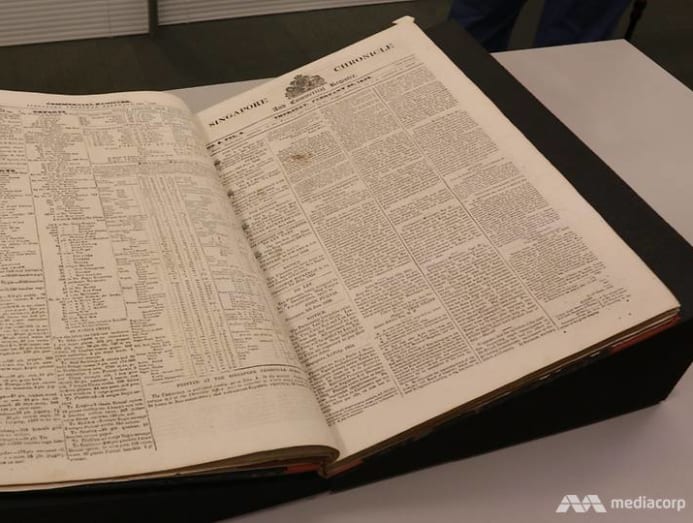
But 1834 editions of the Singapore Chronicle and Commercial Register – the country's first newspaper established a decade earlier – bear witness just that.
The newspaper focused on merchandise news, with ship arrivals and import inventories dominating its densely filled pages.
There's the usual rattan and rice from Palembang, and soap and butter from Batavia (present-day Jakarta). Then there'south the unusual: Elephant teeth from Siam, rifles from Liverpool and opium from Calcutta.
While these were valuable commodities those days – ivory was used to make jewelry and religious objects, while rifles were used to hunt game – the opium trade is far more than intertwined with Singapore'south past.
"Why is this newspaper and then important?" asked senior librarian Gracie Lee, who works in the National Library Board's (NLB) rare materials drove where original editions of the Singapore Chronicle are kept.
"I think nosotros oft hear that newspapers are like the first rough drafts of history. This contains a treasure trove of historical data on early on Singapore."
READ: Finding yourself - and your roots - in the National Athenaeum
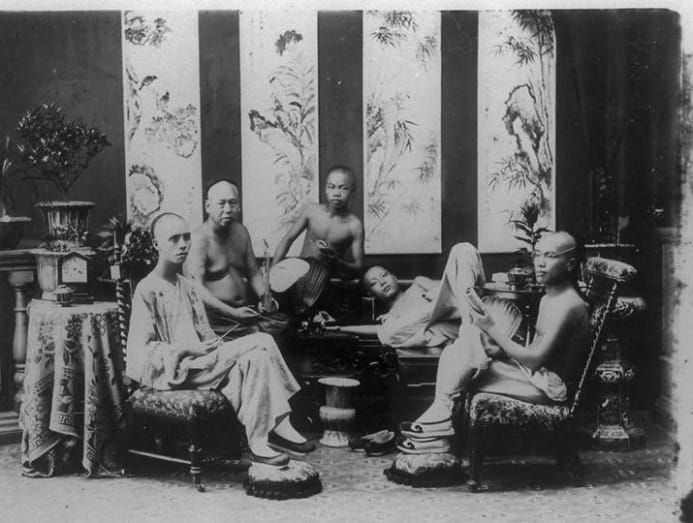
Ms Lee said opium was cultivated in British Republic of india, rolled into balls and stored in chests, then brought to Singapore to exist candy into dissimilar grades. Chinese coolies in Singapore usually got the poorest quality, she added.
With the institution of Singapore every bit a gratuitous port, the opium tax-farming system was introduced as 1 way to raise revenue, according to NLB's infopedia on Singapore. Shopkeepers would also recover ash from smoked opium and sell it at cheaper prices.
The colonial government passed the Opium Regulation in 1830, and until 1910, the annual revenue from opium deemed for an average of 30 to 55 per cent of its total income.
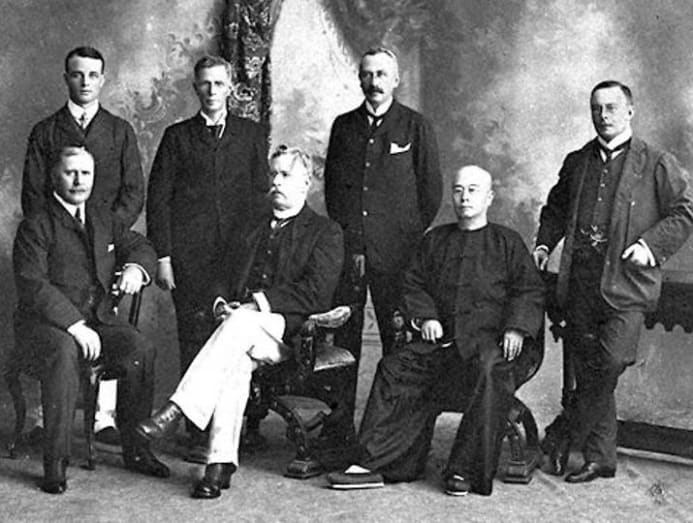
Just the Singapore Chronicle is just one of some 15,000 items in the rare collection that tell dissimilar stories of Singapore'south history. It contains significant materials on Singapore and the region dating equally far back equally the 15th century.
"These materials are inherited from the Raffles Library collection, simply also contempo acquisitions and donations," Ms Lee, 44, told CNA, referring to Singapore'southward kickoff public library which opened in 1845 under a different proper name.
"Then they would be things like travel accounts, European travel writings on Southeast Asia, remittance letters or maps. Yeah, all sorts of things that y'all tin can imagine."
As the name of the collection suggests, these things also take some caste of rarity.
The oldest artefact in the drove is a 1478 map of Southeast Asia based on work by the famed astronomer and geographer Claudius Ptolemy.
And simply three other libraries in the world are believed to concord early bug of the Singapore Chronicle in original hard copies: The British Library, Leiden University Libraries and the National Library of the Netherlands.
"John Crawfurd believed that having such a paper would increase the respectability of Singapore every bit a port," Ms Lee explained, referring to the newspaper'due south endorser who succeeded William Farquhar as the 2nd British resident of Singapore.
"This was meant to be a mercantile newspaper to facilitate trade," she added, extremely reluctant to turn its yellowed pages to protect it.
The bound collection of the newspaper looked more like a frail tome, with its hard encompass, narrow columns and dozens of large portrait pages. Information technology rested on a piece of archival blackness foam designed to support and not contaminate such treasures.
THE RARE GALLERY
While the rare gallery isn't exactly a tomb of lost treasures – information technology's on level xiii of the National Library Building in Bugis, guarded by a solitary no-entry sign and ii layers of locked doors – access is however restricted.
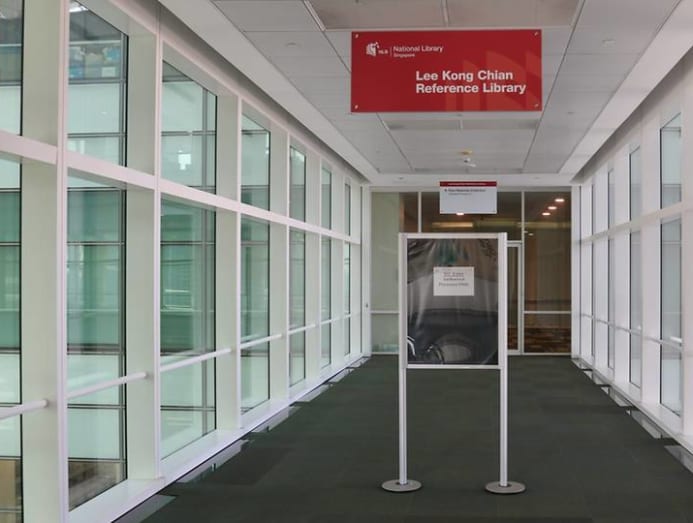
Public tours are conducted only once a calendar month. Larger exhibitions are held on level 10 once a year. And Ms Lee might as well be your modern-day Indiana Jones.
She might be petite, with a bob cut and kind optics, but below this veneer lies a somewhat more steely side to her personality – as a keeper of some of the about valuable artefacts from Singapore'southward history.
When asked where exactly the original items were kept, she replied jokingly: "If I tell you, I'll have to kill you."
CNA was given a private bout on a quiet weekday morning time in early August, when at that place was barely a soul effectually. The almost eerie silence was broken when Ms Lee beeped open up both layers of locked doors.
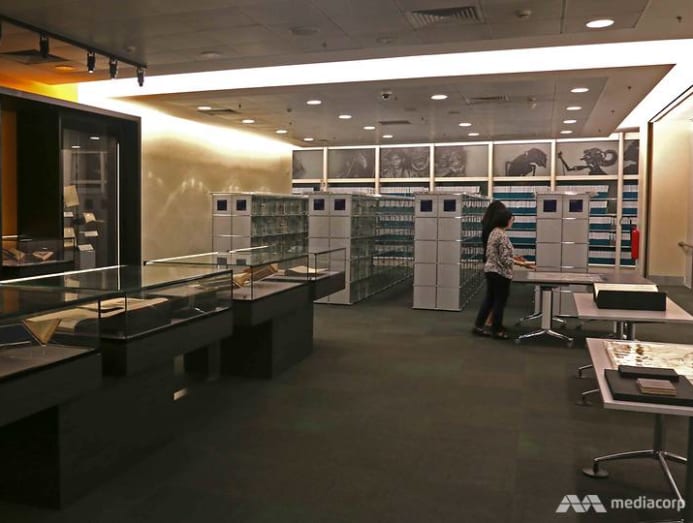
The rare gallery is no bigger than a children'south department in one of Singapore'southward public libraries. But dissimilar the children's department, information technology is gloomy with dark colours and dim lighting. The air is stale and sterile, with the room beingness kept at a abiding absurd temperature.
Calorie-free, estrus and humidity can destroy the rare items, Ms Lee explained.
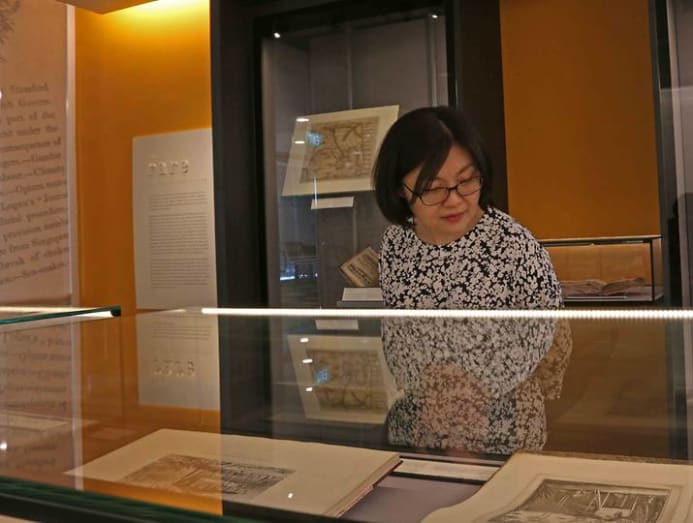
In i corner hung Ptolemy's map, encased in a glass panel fitted with minor lights and a hygrometer measuring humidity. But this was just a replica.
The originals that could be shown were laid out on three split up tables, and Ms Lee proceeded to tell their stories.
DESTINED TO BE A TRADING HUB
Even before the Singapore Relate and the arrival of the British in 1819, there is proof in the rare gallery that Singapore was already slated as a strategic gateway for ships travelling from the W to East.
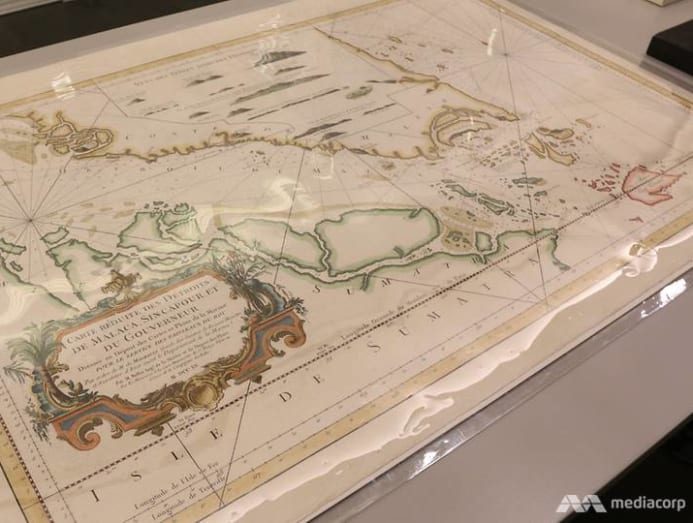
A 1755 hydrographic chart, by the prominent 18th-century French mapmaker Bellin, depicted iii important bounding main passages effectually Singapore linking the Indian Ocean and South China Sea: The Singapore Straits, New Straits and Governor's Straits.
Ms Lee said the map is one of the few to describe Singapore past its local Malay proper name Pulau Panjang, which means Long Isle. It also shows the navigational route ships would take along the Malacca and Singapore Straits.
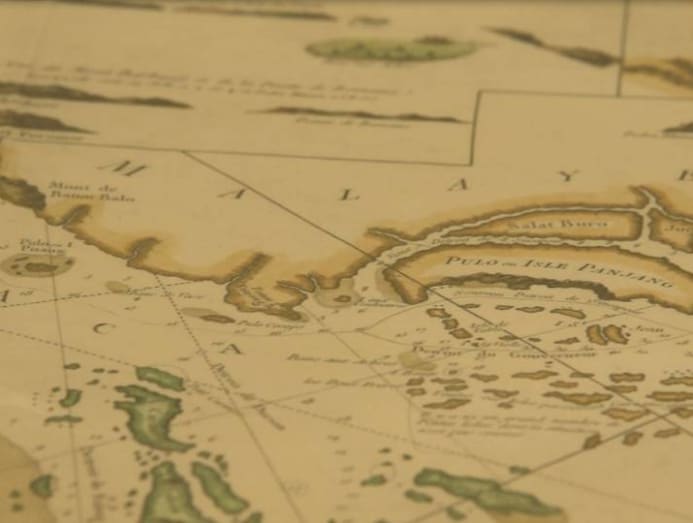
While the map was detailed and intricate – it even had small numbers indicating the depths of waters around Singapore – it didn't exactly become the geography right. Singapore is shaped more similar a banana instead of the four-sided island ordinarily seen today.
Ms Lee offered an explanation: "Considering this is a hydrographic chart, the importance is really how to safely navigate the waters, and not an accurate representation of the shape of the isle."
COAL COOLIES
On a more micro level, another particular showed how Singapore was trying to solidify its status equally a trading hub, with the opening of the Suez Canal creating a much shorter route for ships travelling from Europe to Asia.
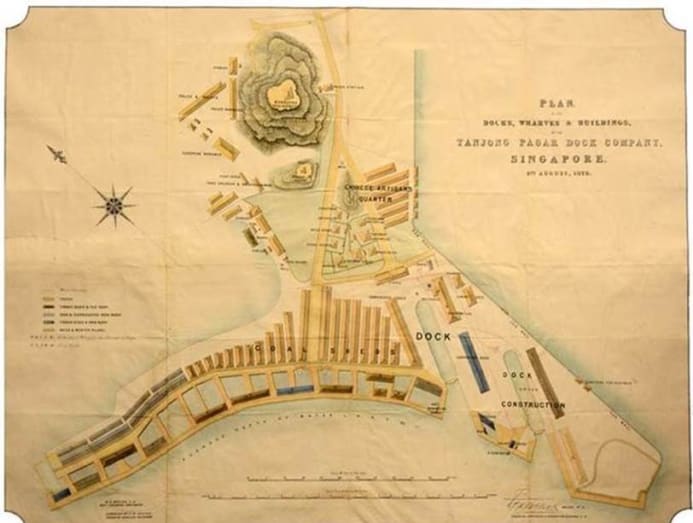
An 1878 programme by the Tanjong Pagar Dock Visitor showed an additional dock being constructed to support an increased demand for shipping services like repairs, Ms Lee said. This would later get today'due south Albert Dock.
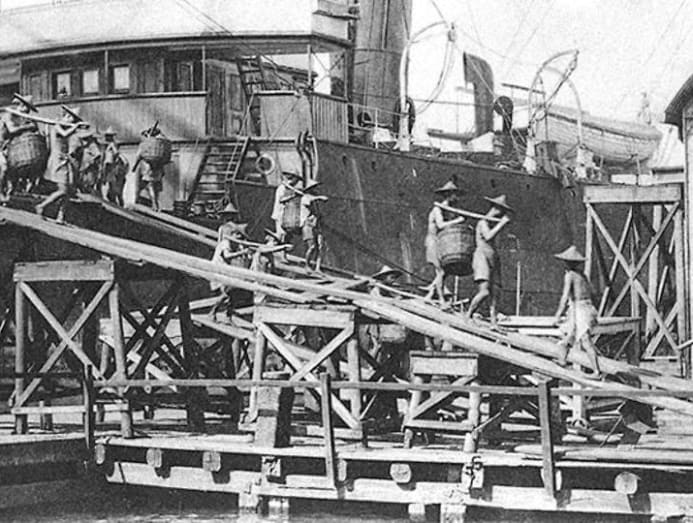
"The Tanjong Pagar dock was a major player in the development of Singapore's history every bit a port," Ms Lee said, pointing to dozens of coal sheds in the programme.
"Singapore and then was a major coaling station; steamships along voyages from the Westward to the East would call in Singapore and take their coal and water refilled."
The plan indicated that the coal sheds, previously fabricated of wood and attap, were constructed with materials like brick and mortar. This is because the plan was produced a year later on a huge fire destroyed most of the coal.
"The fire was so major, information technology took two weeks for it to be brought under control," Ms Lee added. "And so, the company was galvanised to build these coal sheds with more durable materials."
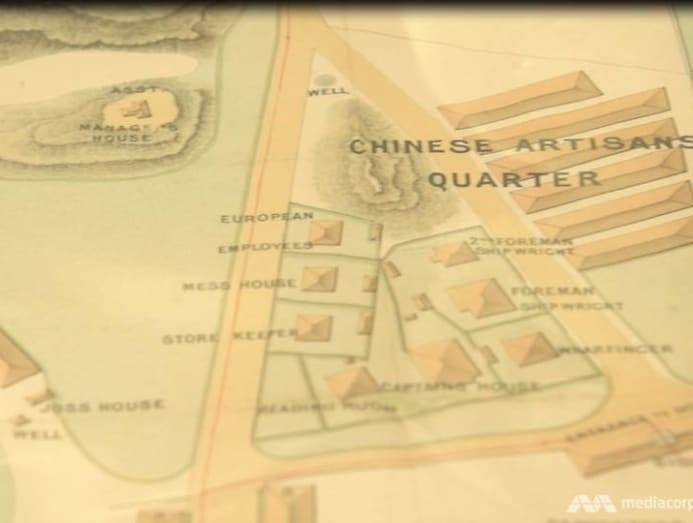
The plan also showed adaptation for the Chinese coolies who toiled through the twenty-four hours transporting coal. In 1874, at that place were well-nigh 300 coal coolies working for the company, with the Chinese forming a majority of its labour forcefulness.
"What's interesting is nearby you lot come across a joss house or Chinese temple to perhaps see their spiritual and protection needs at the time," Ms Lee stated.
PRESERVING RARE ITEMS
The rare and oftentimes fragile materials in the gallery also have their needs.
In the secret storage room, the temperature is kept at around 18 degrees Celsius and the humidity at virtually 55 per cent, lower than the levels in Singapore. There is no light.
"These are the factors that would accelerate the deterioration of paper-based materials," Ms Lee explained. "Materials are also digitised and then we can provide admission while minimising direct handling of the original."
Clean and dry hands are a must earlier whatsoever handling, although there's as well a misconception that gloves are required. Gloves actually become in the way of proper treatment, she added.
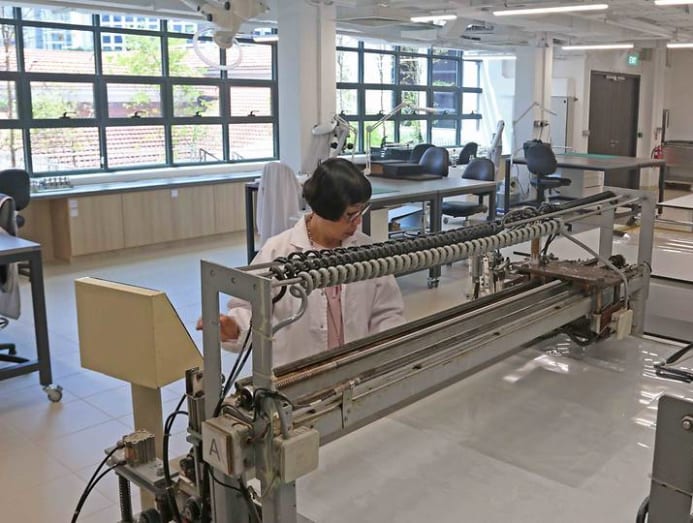
The items themselves are kept in plastic folders or newspaper boxes that protect the items during moving and storage, and permit for non-subversive pasting of important information like the title and barcode. Pens are a no-no in the room.
But these more expensive protective layers cannot be institute in your neighbourhood bookshop. They are made from not-reactive materials like polyester or acid-free newspaper.
They are as well customised for shape and size at the NLB'due south supply centre in Changi S, which is also where rare items first brought in are fumigated to remove pests, repaired if at that place are structural amercement and catalogued for online searches.
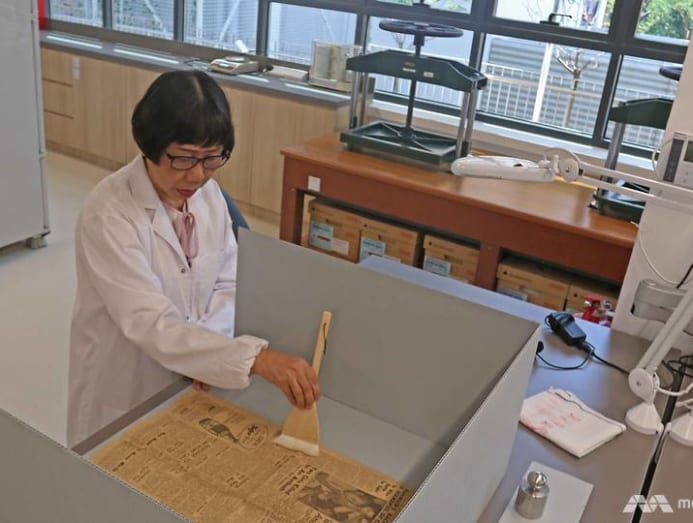
Some conservation techniques include removing dirt using goat hair brushes or Staedtler erasers, and repairing holes through infilling. This refers to filling the hole with a torn-off piece of like thickness newspaper and applying wheat starch paste to make it stick.
Make Information technology NEW OR Continue IT Antiquarian?
But do conservators ever have to practice their best to restore an item to its quondam glory? National Archives of Singapore conservator Ong Fang Zheng, 30, said there's a "thin line" between restoration and conservation.
"A restorer will have a 200-year-onetime work and give it dorsum to you similar it's 20 years onetime," she said. "Every bit a conservator, I will render information technology to y'all and it nonetheless looks 200 years old. But information technology'southward structurally stable."
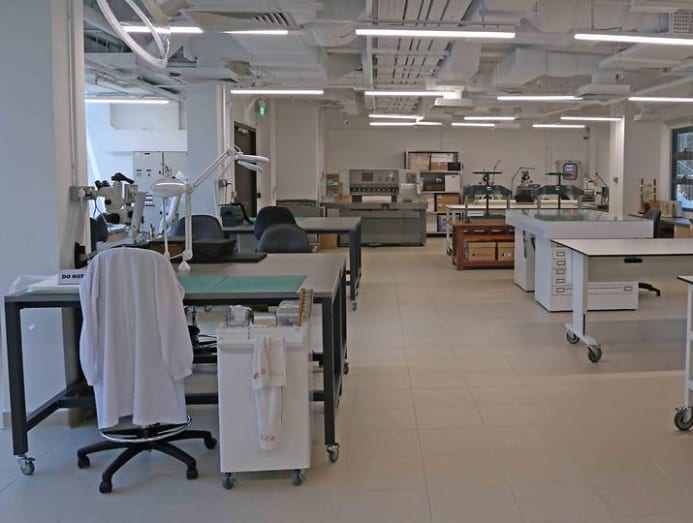
Ms Ong acknowledged that conservators do restore items that are desperately damaged, just said information technology's ultimately a question of purpose.
"Restorers are more than for the art market place – things need to look good. For united states of america, it's well-nigh the historical, cultural aspect. And the authenticity and integrity of the object," she added.
"Conservators are not magicians. Basically, all we're doing is trying to retard the degradation procedure so our things can last centuries for time to come generations to savour."
A THIRST FOR KNOWLEDGE
Back at NLB's rare gallery, Ms Lee's task is also to somewhat immortalise the rare items – by learning equally much every bit possible about them and spreading the knowledge through tours, workshops and online blogs.
"Equally I work through and research a collection, I also begin to notice new aspects of Singapore history that I didn't know before," she said.
"I savor meeting patrons or researchers who come up to expect at this collection because they will be able to share with me things that I've not discovered from these materials."
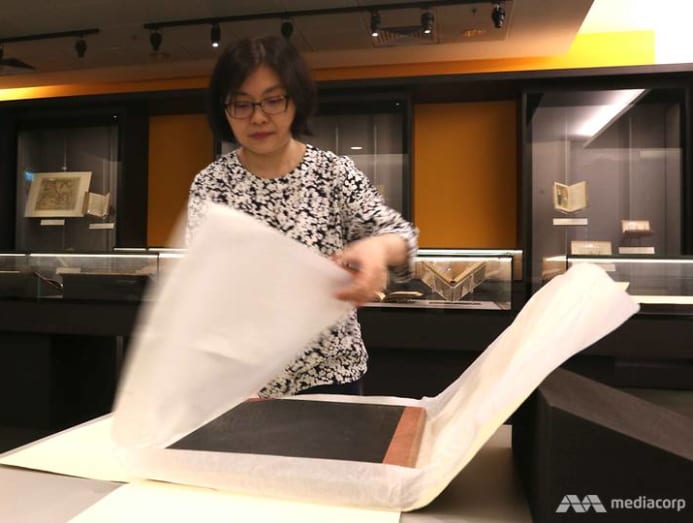
The ever-curious Ms Lee has been with NLB for 13 years, previously working in the public libraries and also at the supply centre. Well-nigh v years ago, an opportunity to work with the rare collection came up. She didn't demand to call up twice.
"I've always had an interest in history, so being able to work with these original materials is really very fascinating," she added, smiling. "It'south a different side of librarianship."

Ms Lee works with a team to research and write about the rare items, as well as search for others that can be bought and added to the drove.
A committee will evaluate the detail based on criteria similar market availability and how information technology fits into the collection. Prices range widely – something found on eBay could exist considered rare also.
"Nosotros might select from catalogues that we take received from dealers, or online alerts that nosotros've gear up up," Ms Lee said. "We also scour the Net and await through auction sites to see if at that place are relevant materials we can larn."
LONG HOURS AND LANGUAGES
Information technology's clear that Ms Lee loves her chore. She fifty-fifty spoke at length most items that help prop upward or hold downwards rare items during viewing. There are foam pieces in different shapes, a edible bean bag that looks like a pillow, and a long, thin weight which she fondly calls "snake".
Only the task has its challenges equally well.
Ms Lee works nine-and-a-half-hour shifts from Mondays to Fridays and sometimes on the weekends, when she conducts tours or helps customers with enquiries.
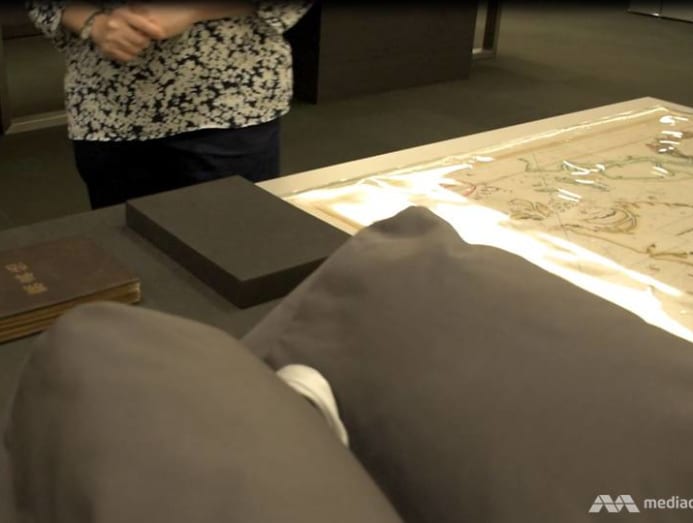
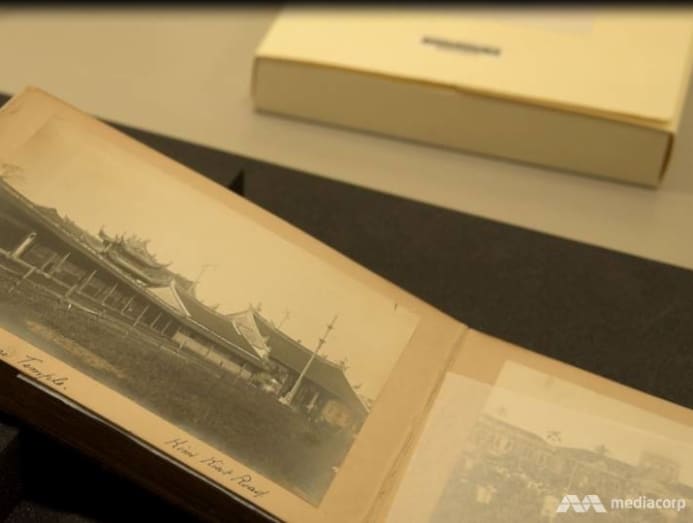
She might also not exist able to fully understand the rare items, which might contain foreign languages like French or Portuguese. But she was quick to explain the Japanese characters on the cover of another rare item, an album containing photos of early 19th-century Singapore.
"Shashin, meaning photo album," she said, noting that she has colleagues who tin understand unlike languages.
Ms Lee is eager to learn and even more eager to teach. She'due south heartened when the 45-minute public tours become an hour or longer because "people are just so interested to find out new things about Singapore".
"I think the universe of knowledge is very wide," she stated. "Then sometimes information technology's not possible to know everything, but I remember we try our best."
Source: https://cnalifestyle.channelnewsasia.com/singapore/nlb-rare-collection-19th-century-singapore-ivory-rifles-opium-228961
0 Response to "Ivory, rifles and opium: NLB's rare collection reveals Singapore's 19th-century shopping list"
ارسال یک نظر